
CONCERNS GROW, WHILST THE GDP FAILS TO DO SO
- Rohan Naval
- May 25, 2022
- 3 min read
The Gross Domestic Product (GDP) is defined as the market value of all final goods and services produced within a country over a specific time period. Although the metric has its shortcomings, such as the exclusion of the informal sector and income inequality, it is one key factor that we can use the statistic for when diagnosing the economic state of a nation: economic growth. GDP statistics allow us to analyse the impact of macroeconomic policies and accordingly assess their impact. Hence, the GDP statistics for Q1 of 2022 in the US published by the Bureau for Economic Analysis (BEA) were rather significant when it reported a -1.4 percent rate of growth. This was not only unexpected but rather scary, as projections from institutions such as the Federal Reserve Bank of Philadelphia would have indicated much more positive statistics such as 1.8% growth in Q1. Hence, it behoves us to look further into their report, find out the cause of this economic slowdown, and possible solutions to this problem.
The report published by the BEA, on April 28th 2022 is a 16-page report which consists of the GDP trend since Q2 of 2018, eight tables regarding different statistics around GDP change, and comments by the BEA on the statistics and potential reasons for the trend. The BEA is in charge of calculating and keeping accounts of the following statistics:
Real GDP
Current Dollar/Nominal GDP
Consumer Price Index (CPI)
Disposable Personal Income
Personal Savings
Of these statistics, the real GDP and CPI are of the most importance. The real GDP helps indicate the level of growth, by factoring in the CPI (rate of inflation) to adjust for increases in the price of goods over a year. Real GDP is generally calculated as a summation of consumer expenditure, producer expenditure, government investment, and the net balance of imports and exports.
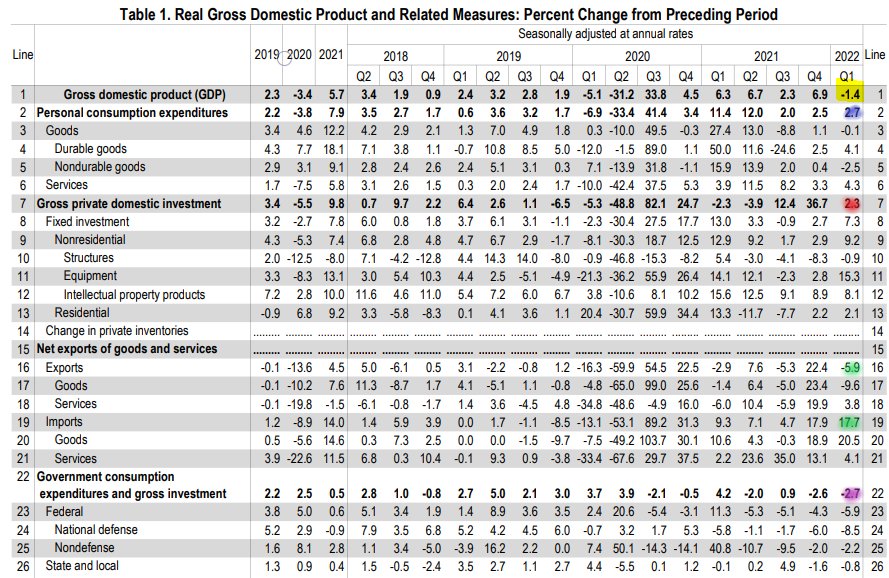
Table 1, NEWS RELEASE, BEA First Estimate Report
The -1.4 percent (in yellow highlight) indicates the overall decrease in economic output from Q4 of 2021 to Q1 of 2022. The consumer and producer expenditure have both increased (2.7 percent and 2.3 percent, respectively). However, the decreases in Government expenditure (-2.7 percent) and more concerningly, net exports, resulted in a net decrease in real GDP.
Other statistics from the report, regarding disposable personal income, were similarly concerning. There was a decrease in real disposable personal income, whereas the personal savings rate increased. These quotes from the report represent their findings:
"Disposable personal income increased $216.6 billion, or 4.8 percent, in the first quarter, compared with an increase of $20.1 billion, or 0.4 percent, in the fourth quarter. Real disposable personal income decreased2.0 percent, compared with a decrease of 5.6 percent."
"Personal saving was $1.21 trillion in the first quarter, compared with $1.39 trillion in the fourth quarter. The personal saving rate—personal saving as a percentage of disposable personal income—was 6.6 percent in the first quarter, compared with 7.7 percent in the fourth quarter."
One of the reasons for the decrease in real exports is due to the rapid hike in inflation, and the higher cost of imports into the US. However, the increase in imports, which is a withdrawal from the GDP, was very noticeable. Capital goods, or goods that are used to produce goods by firms, are the US’s biggest imports. The Commerce Department has claimed that businesses that wished to build their inventories needed to import goods from foreign nations, owing to domestic supply issues in the US, which have resulted in the overload of ports such as the Port of Los Angeles. Furthermore, food and oil imports have also been at an all-time high, this time owing to the Russia-Ukraine War. This war has sparked fears over a global food shortage, given that the sanctions on Russia have resulted in a shortage in fertiliser. In addition, the sanctions on oil have also sparked panic buys, as the previous overdependence on Russian oil has resulted in countries needing to reroute their supplies.
In conclusion, although these numbers are concerning in the sense that they missed predictions, these numbers are the result of exogenous circumstances, which are likely to affect this quarter alone. Other economic indicators, such as the 0.3 percent increase in employment, indicate that there are positive signs that show a post-pandemic recovery. However, other findings from the report such as the increase in the price level on the CPI, and the decrease in real personal income, as previously mentioned, tell us that there are long-term problems that the US economy must address for stable and strong economic growth.
References
https://www.investopedia.com/ask/answers/what-is-gdp-why-its-important-to-economists-investors/#:~:text=Gross%20domestic%20product%20tracks%20the,growing%20or%20experiencing%20a%20recessionhttps://www2.deloitte.com/us/en/insights/economy/us-economic-forecast/united-states-outlook-analysis.html


Comments