
The Tragedy of the Commons: developments and solutions
- Sarah Baek
- Dec 9, 2021
- 4 min read

Updated: Dec 17, 2021
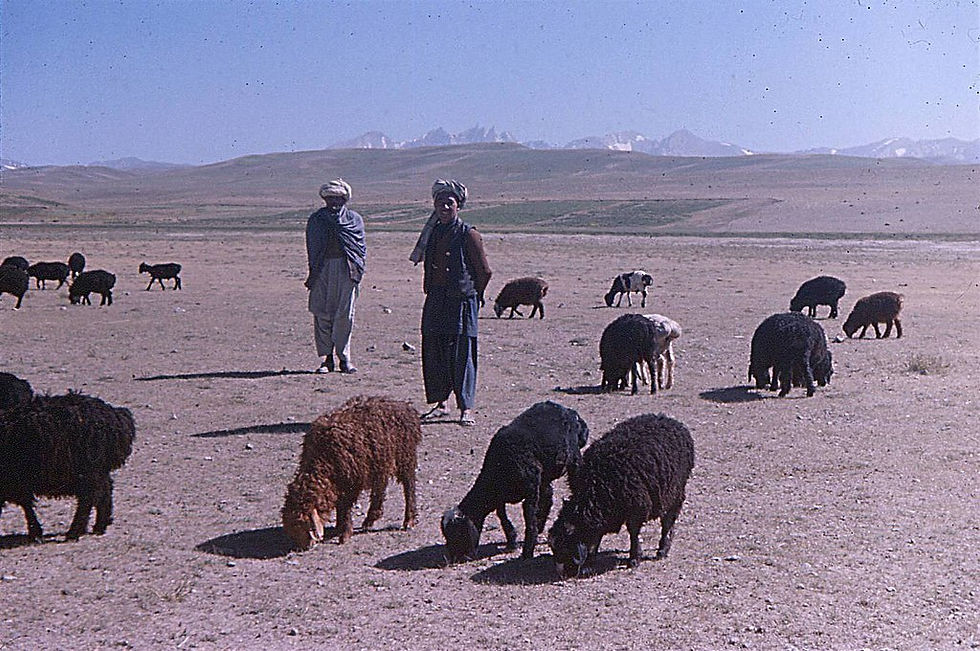
Above is a picture of an over-grazed farm in Afghanistan. The tragedy of the commons is one way to account for overexploitation of natural resources.
The tragedy of the commons is a situation where individuals who maximise utility and have access to the commons[1] lead to its destruction because the users act independently and to their self interest. Rather than conserving resources for social benefit, they will eventually deplete under this dilemma.
Then, Elinor Ostrom, 2009 Nobel Laureate in Economics, showed in her book Governing the Commons how open-access resources can be used without collapse, through appropriate methods of governance. From studies of local communities in Mongolia and other nations, she discovered how users had jointly used natural resources "in a way that is both economically and ecologically sustainable,” according to the Nobel Prize.

Of many examples that support this concept, the Grand Banks of Newfoundland is the most famous one. The Grand Branks, location shown above, was arguably the world’s richest fisheries area. However, the Grand Branks fishery closed in 1992 due to overfishing and the collapse of several species in the late 20th century.
While Hardin’s exploration involved the physical world, the tragedy of the commons now expanded to digital commons, cultural commons, urban commons, and knowledge commons.
In the digital world, public goods are non-rival and almost infinitely plentiful. However, this infinite supply of common, open, and anonymised data and digital goods can still be tragic and is liable to exhaustion, albeit in a different manner.
At the moment, pollution in the infosphere is the most important implication. This includes overproduction of data resulting in redundant data that causes clamour and distorts communication channels. An example is a spam, which accounts for 45% of email traffic. Furthermore, the unrestricted usage of digital commons leads to misinformation, fake news, and crime. The manipulation, insecurity, and confusion will lead to human costs.
An example of digital commons policy is the European Commission’s Open Source Software Strategy 2020-2023. The strategy states that "collaborative working methods will be the norm within the community to foster the sharing of code, data and solutions." This will give Europe a “chance to create and maintain its own, independent digital approach and stay in control of its processes, its information, and its technology.”
As said by Ostrom, the tragedy of the commons is a complex issue that requires complex solutions.
Among many, an obvious solution is government regulation to limit the amount of common goods available for individual consumption. Permit systems exist for mining, fishing, hunting, and more, and limits to pollution show how a government intervenes on behalf of the commons.
Another solution is privatisation which incentivises the new owner to maintain its sustainability. This process, argued for by Lloyd, has mostly occurred by a government taking control over the common good then assigning property rights to individuals.
However, there are controversies to this policy. For example, a firm which seeks an immediate financial return has a much shorter time horizon. Also, one must be careful in regulating the commons — some economists argue that the impending tragedy of the commons is a consequence of policies that ban private poverty and advocate public property expansion.
Furthermore, negative externalities are the best-known feature of the tragedy of the commons. For example, every time person A drives a car, person B suffers from pollution. Economists have looked for ways to internalise such externalities, requiring the users of resources to pay for the consequences of its uses. This allows alternative solutions between privatisation and regulation to be provided. An example is the gasoline taxes which include the cost of road maintenance and of air pollution. This method combines the flexibility of privatization and minimises the extent of government regulation.
Supranational organisations can contribute as well. The United Nations Moon Treaty, Outer Space Treaty, and Law of the Sea Treaty include the international law that assigns some areas or resources to subjects[2].
Ostrom’s research on the tragedy of the commons is not only a solution but also evidence that the situation is only a potential outcome, not a guaranteed outcome.
As previously written, Ostrom demonstrated that an open-resource system can exist with “regulated access that allows its members to agree and cooperate to exploit the resources without collapse.” Design principles such as voluntary agreements with informal arrangements and local monitoring can overcome the tragedy of the commons. She believed that civic responsibility will make the outcome more successful.
For example, in old rural communities of Mongolia, the tragedy of the commons has not occurred. For reasons such as education or cultural incorporation, members have accepted public interests and private interests as equals. Thus the autonomous regulation has allowed effective utilisation of common resources without depletion. Such a case was possible, as its members have cooperated for a significant time period and established traditional networks.
Overall, it is important to acknowledge that the tragedy of the commons is a potential outcome and not a guaranteed one. As this situation extends into fields of law, medicine, communications, and more, economists must look for effective measures to prevent it.
References
Notes
[1] The commons mean a scarce resource that provides tangible benefits, however, nobody has exclusive ownership of it. It is also known as the open-access resource.
[2] This is also known as the Common Heritage of Mankind.
If you’d like to know more about the Coase Theorem and the tragedy of the commons, refer to this presentation.


Great read—stories that explore deeper meaning and personal identity leave a lasting impression. The concept behind Brad Laidman Clark Kent existential story feels both creative and intellectually engaging
Valuable points shared here—professionalism and strong presentation make a difference in every industry. For writers aiming to expand their audience, Book Publishing services provide useful support in transforming creative ideas into polished and professionally published books.